
Increasing employee engagement has long been seen as a powerful way to drive growth, as was further demonstrated by Microsoft’s Work Trends Index research published earlier this year. The findings were clear: on average, each additional point of engagement reported by employees correlated with a +£36,827 difference in market cap per employee. So, high employee engagement correlates with stronger financial performance, and staff engagement and productivity are mutually reinforcing.
While the UK is forecast to escape recession, high interest rates and low productivity are still expected to hold back GDP growth. Any organisation aiming to outperform the market must find new ways to drive up engagement and productivity more than the competition.
One way of doing so is by improving the digital employee experience - ensuring people have the tools they need to perform at their best, which is why HR leaders have such a crucial role to play. Especially now, because staff are seriously struggling with ‘digital debt’ - the accelerating volume of emails, messages, notifications and meetings which has exceeded our capacity to process it all.
The heaviest users of modern productivity apps can send and receive up to 150 chats and get more than 250 emails a day. Meetings are up 300% globally, per person, since 2020. Having too many meetings, and unproductive meetings are now reported as top productivity disruptors. Microsoft’s ongoing Work Trends Index research shows this is having a major impact on staff’s day to day performance: 62% report spending too much time searching for information, and 64% are struggling with having enough time and energy to do their job.
The good news is that, with the arrival of generative AI, organisations have a new tool with the power to transform this experience for employees.
How AI unlocks a more rewarding employee experience
Copilot for Microsoft 365 is the everyday generative AI companion that’s integrated into the Microsoft 365 apps people use every day, including Outlook, Word, PowerPoint, Teams, and Excel. We have been tracking the feedback from staff taking part in our early access programme, and the findings should make compelling reading for HR leaders.
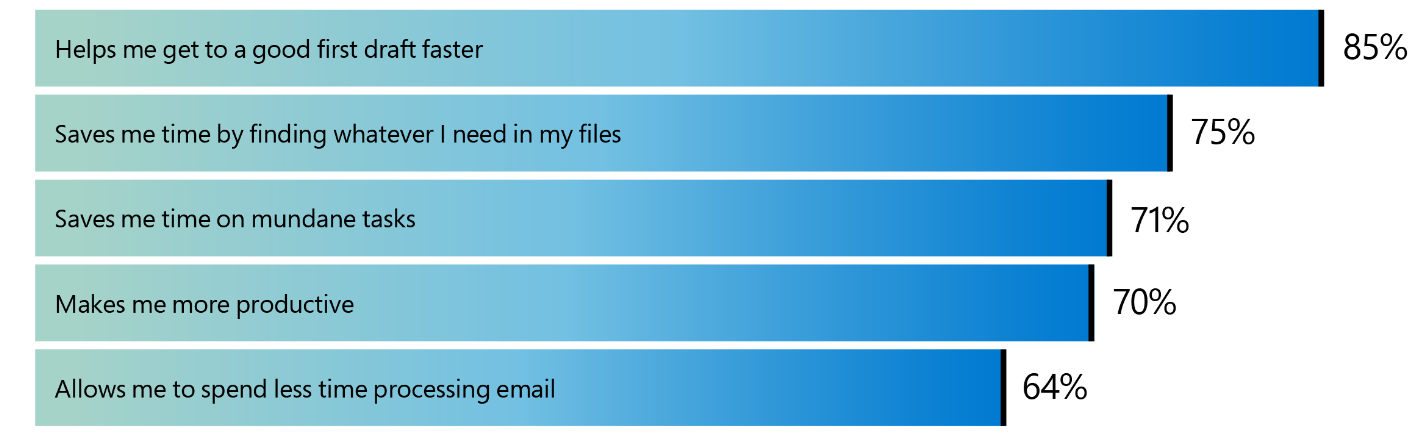
70% of Copilot users said they were more productive, and overall, users were 29% faster at a series of tasks (searching, writing, and summarising). This is testament to AI’s potential for reducing burnout, not least in the public sector, where social workers, for example, desperately need to process admin more efficiently and get time back to recover physically and mentally.
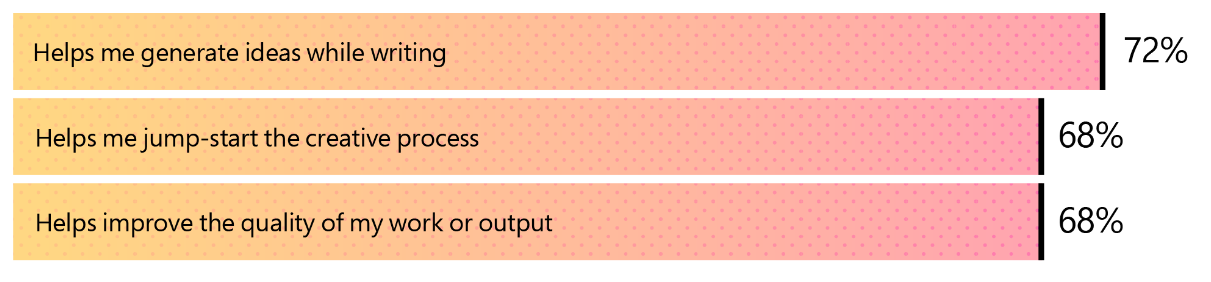
68% said it improved the quality of their work, and 68% also said it helped jumpstart the creative process generally, with 85% of users saying Copilot helps them get to a good first draft faster. This means less procrastination from ‘blank page syndrome’ whether someone is creating a speech, email, spreadsheet, or presentation, making work more accessible to everyone - including neurodivergent people.

Users were also able to get caught up on a missed meeting nearly four times faster, and 75% of users said Copilot “saves me time by finding whatever I need in my files”, and 64% of users said Copilot helps them spend less time processing email. Crucially, 77% of users said once they used Copilot, they didn’t want to give it up - making it a valuable tool for staff retention, particularly in industries like the legal sector where an intense battle for talent makes every edge worth exploring.
It's also worth noting that Copilot users don’t just expend less effort, they feel like they do too: 85% say the effort needed to complete tasks was reduced. Having more time and energy to focus on more meaningful and rewarding work can only benefit company culture and the quality of employee experience.
A practical tool for HR teams, too
HR teams can benefit from generative AI just like anyone else and we recently ran an in-house demonstration for Microsoft UK’s own business partners, showing what Copilot for Microsoft 365 could do for them.
First, we used Copilot to research which UK organisations currently offer some of the best paternity leave options, which identified and summarised four or five great examples. Then, because Copilot is connected to Microsoft’s internal graph – which means it has access to selected company data, we used it to find our latest paternity policy and summarise that in comparison.
Next, we used Copilot in Word to draft a brief whitepaper outlining any potential opportunities for continuing to evolve our own paternity policy - based on the external examples and internal documentation Copilot had found. It was a solid four pages that took just 10 minutes to put together - a task that could previously have the best part of a day. It still needed checking and editing by an HR expert, but it was a great start that included accurate summaries, well researched data and insights, and even gave the HR team some ideas that they hadn’t thought of yet.
Another use case our HR business partners loved was candidate interviews, where Copilot can reduce the admin burden and accelerate the process, improving the experience for hiring managers and interviewees. For example, it can review someone’s CV and suggest helpful questions based on their skills and experience. After the interview, Copilot can summarise the key points discussed, provide a sentiment analysis, and draft multiple follow up emails, internally for HR colleagues and for the candidate, feeding back as appropriate.
Accessing and understanding the employee experience
What makes Generative AI so powerful for HR leaders, is that, yes - it’s the new User Interface (UI) for accessing the world’s knowledge, but it’s also the best available UI for understanding your organisation’s information, as well as being an agent that helps you take action.
For example, Microsoft Viva is an integrated employee experience platform that brings together internal comms, workplace analytics, goal setting and learning management – and Copilot will become available within the Viva suite in 2024. This will enable HR leaders and teams to use natural language prompts to easily query data, with Copilot answering questions, creating personalised, dynamic reports, and ultimately guiding HR staff with whatever self-service insights or actions they need. Which could mean understanding team health, setting new priorities with OKRs, or identifying the best upskilling opportunities to support career growth.
The arrival of generative AI and its seamless, effective integration into the productivity apps and employee experience data HR teams use every day represents a new leadership opportunity for HR professionals. Helping your organisation adapt to change is never easy, but the vast promise and immediate benefit of these tools to change the way we work, for the better - cannot be ignored.
If you’d like to learn more about how AI is being used to boost productivity, improve employee engagement and empower HR teams with more data-driven insights, please visit the Microsoft Copilot hub.